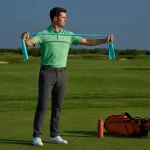
The golf swing is a complex, full-body movement, yet the shoulders play a pivotal role in power, control, and injury prevention. Incorporating targeted golf shoulder exercises into your fitness routine can significantly improve your swing mechanics, increase clubhead speed, and reduce the risk of common shoulder injuries like rotator cuff strains. Strong, stable, and mobile shoulders allow for a greater range of motion in the backswing and a powerful, controlled release through impact. Therefore, don’t let weak or stiff shoulders limit your potential on the course.
Optimal shoulder health is not merely about strength; it also encompasses mobility, stability, and endurance. For golfers, these elements translate directly into a more efficient and repeatable swing. Furthermore, well-conditioned shoulders help absorb the forces generated during the swing, protecting the delicate joints and tissues from wear and tear. This article will guide you through essential movements and strategies to build resilient shoulders, enhancing both your performance and longevity in the game.
Understanding the Golfer’s Shoulder: Why Specific Training Matters
The golf swing places unique demands on the shoulder joint. During the backswing, the lead shoulder undergoes significant internal rotation and abduction, while the trail shoulder experiences external rotation. Conversely, the downswing requires powerful internal rotation and adduction from both shoulders, particularly the trail shoulder, to generate clubhead speed. Consequently, imbalances or weaknesses in the surrounding musculature can lead to inefficiency, pain, and injury.
Many golfers focus primarily on larger muscle groups, often neglecting the smaller, yet crucial, stabilizing muscles of the rotator cuff and scapular stabilizers. These smaller muscles are vital for maintaining the integrity of the shoulder joint throughout the dynamic golf swing. Moreover, neglecting these areas can lead to compensatory movements, placing undue stress on other parts of the body, such as the lower back or elbows. Therefore, a targeted approach to shoulder training is indispensable for any serious golfer.
Key Golf Shoulder Exercises for Stability and Mobility
To build resilient shoulders for golf, focus on a balance of stability, strength, and mobility. Here are a few essential golf shoulder exercises. In fact, these are foundational for any golfer looking to improve their game and prevent injury.
1. Band Pull-Apart
Hold a resistance band with both hands, palms down, arms extended in front of you at shoulder height. Keeping your arms straight, pull the band apart by squeezing your shoulder blades together. This action strengthens the upper back and rotator cuff. Perform this exercise slowly and with control, emphasizing the squeeze between your shoulder blades. Aim for 2-3 sets of 10-15 repetitions. This movement is excellent for posture and counteracting the forward-rounded posture often seen in golfers.
2. External Rotations with a Band
Secure a resistance band to a stable object at elbow height. Hold the other end with one hand, elbow bent at 90 degrees and tucked into your side. Rotate your forearm outwards, away from your body, keeping your elbow in close to your torso. This directly targets the external rotators, which are crucial for shoulder health and swing stability. Specifically, these muscles help decelerate the club at the top of the backswing and stabilize the shoulder through impact. Complete 2-3 sets of 12-15 repetitions on each arm.
3. Wall Slide
Stand with your back against a wall, arms bent at 90 degrees with your forearms and hands touching the wall. Slowly slide your arms up the wall, keeping your forearms and hands in contact, then slide them back down. This improves scapular control and overhead mobility. It helps to engage the serratus anterior, a key muscle for scapular stability. Furthermore, it can alleviate tightness in the chest and front of the shoulders. Focus on smooth, controlled movements for 10-12 repetitions over 2-3 sets.
4. Dumbbell Y-Raise
Lie face down on an incline bench or prop yourself up on a stability ball. Hold light dumbbells with palms facing each other. Keeping your arms straight, raise them in a
Related reading: